Skin tone: why b > a is not a strict rule
A useful rule, but not a strict one
Anyone who corrects skin tones in Lab soon learns a rule: on skin, b* is greater than a*. So when we find a* above b* on a face, we immediately think of an error or a colour cast to remove.
Lab measurements tell a more nuanced story. In a sample of Caucasian skin, 42.5% of face measurements have a* greater than b*. And the zone matters a lot: on the cheek this happens in 10.9% of measurements, on the chin in 67.2%.
“b* greater than a*” remains a good general guideline, but it cannot become a strict rule. Used as a law, it leads us to “fix” faces that have nothing to fix.
Lab in a few lines
Lab describes every colour with three numbers:
- L* is lightness: 0 is black, 100 is white.
- a* goes from green (negative values) to red (positive values).
- b* goes from blue (negative values) to yellow (positive values).
Think of a* and b* as a map seen from above, with the neutral tones at the centre: white, greys and black depending on lightness. All skin measurements fall in the area between red and yellow, where a* and b* are both positive.
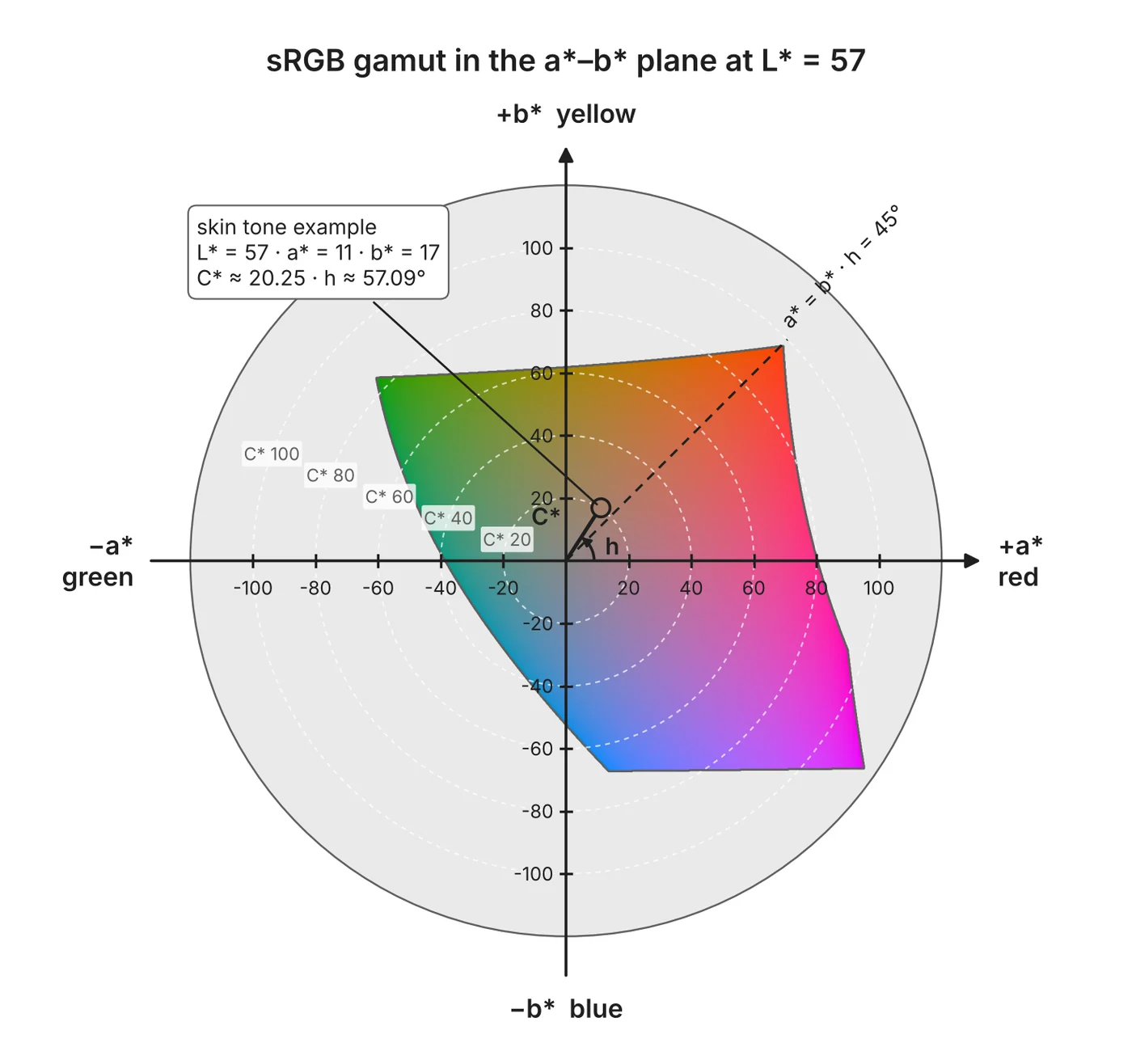
“a* > b*” simply means that the number a* is larger than the number b*: on the map, the point sits below the dashed 45° line. The diagram also shows chroma C*, the distance from the centre (the larger it is, the more intense the colour), and the hue angle h, the direction of the colour.
Where the measurements come from
The numbers come from the Human Skin Colour Database, published in 2025 by the CIE [1], the international body that sets the rules for measuring colour. It contains 11,235 skin measurements, taken on people from different groups and on different areas of the body.
These are not colours sampled from photographs but instrument measurements: the skin is read by a spectrophotometer, a device placed on the skin that lights it with a controlled internal light and measures how much light comes back. Following the researchers’ protocol [2], the skin is free of make-up and creams, and the instrument is placed without pressing, because pressure changes the colour.
Two things to keep in mind. The counts refer to measurements, not people: each person was measured at several points. And the database is not a representative sample of the whole population: it describes the people who were measured.
The face, zone by zone
The most interesting result comes from a group of 64 people with Caucasian skin, measured at five points on the face: 320 measurements in total. In 42.5% of cases a* is greater than b*, but the percentage changes a lot from zone to zone.
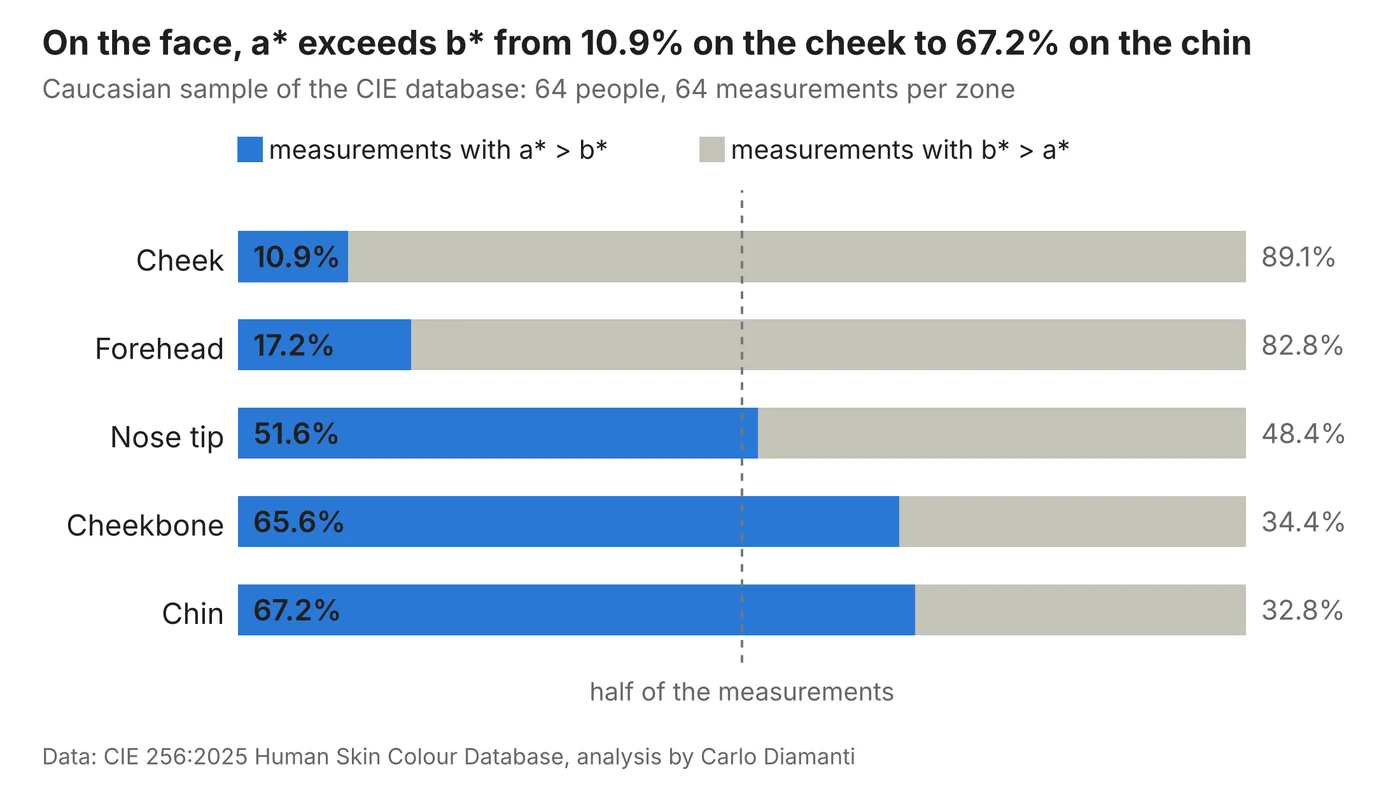
In the Caucasian sample analysed, b* exceeds a* on the cheek and forehead in most measurements, but not in all of them: here too we find the opposite relationship, in 10.9% and 17.2% of cases respectively. On the cheekbone and chin a* > b* prevails instead, yet about one measurement in three shows b* > a*.
This is exactly what the percentages show: a tendency can be frequent without applying to everyone. None of the five face zones analysed shows the same relationship in every person.
The frequency also changes from one sample to another. In a group of Spanish participants, measured only on the forehead and cheek, a* exceeds b* in 42.6% of cases, against 14.1% for the Caucasian sample on the same two zones. In the other groups of the database the exceptions are rarer, but they exist.
A note for Photoshop users
The values in this article are in Lab with a D65 reference, as in the database. Photoshop computes Lab with a D50 reference [3], so the numbers you read in the Info panel may differ.
To get an idea of how much, we adapted the database values to the D50 reference. In the Caucasian sample, the face measurements with a* greater than b* go from 42.5% to 46.9%. In Photoshop, then, the exceptions to the rule are even more frequent.
What changes in retouching?
- Don’t judge the whole face from a single point. Cheek, forehead, nose, cheekbone and chin have different values, and that is normal.
- Don’t automatically correct a zone because a* exceeds b*. On cheekbones, chin and nose it can be completely natural.
- Look at skin, light and the rest of the image together. A colour cast usually affects neutrals and other surfaces too; a local redness does not. But be careful: a neutral object can look coloured if the light in the scene is coloured, so it doesn’t necessarily have to be made perfectly grey. Mixed lighting and reflections can be misleading: look at the whole picture.
- Use the numbers as a reference, not a target. The b* > a* rule points in a direction: it is not a value to force onto every point of the face.
In conclusion
The data describe the measured sample, not the whole population. But they show something important for anyone who retouches: an a* value higher than b* does not, on its own, prove a colour error, not even in the zones where the opposite relationship is more common.
In a photograph, lighting, coloured reflections from the surroundings, make-up and raw development choices also come into play, and they can further change the relationship between a* and b*. A colour variation can therefore belong to the skin, or depend on how it was lit, made up and photographed.
Before correcting it, let’s ask whether it is consistent with the face, the scene and the result we want. Numbers help us look more carefully; on their own they don’t decide what colour the skin should be.
Further reading
This is the accessible version. The full article will be available soon, with everything behind the numbers: how the measuring instruments work, the complete tables by group and body area, the D65 to D50 conversion for Photoshop users, and the full drawing of the Lab space.
Sources
- CIE, Measurement of Human Skin Colour, Technical Report CIE 256:2025, and Human Skin Colour Database. cie.co.at
- Lu Y., Xiao K., Pointer M. et al., The International Skin Spectra Archive (ISSA), Scientific Data 12, 487 (2025). nature.com
- International Color Consortium, minutes of the Medical Imaging Working Group, April 2014: Photoshop computes CIELAB values with a D50 white. color.org